Let’s go for a bit of trip on this one. If you can work out someones main modality you can connect and also be able to communicate in a way that is ‘so their language’ and the affects are amazing.
Understanding how people take in information in general, whether it’s for learning purposes, having a conversation or doing business is key to making a real difference in how your communicate and how effective can be.
The below is written in the context of education with ways in which students learn. We are all students of the world and we never stop learning. Maybe some slow their learning at times but we are always taking in new information and if its not in the form of our favoured modality it can be tricky to stay attentive and retain the information. Below we cover the main modalities and please remember that we all draw on each one at different times. Depending on someones modality they will behave possibly unexpectedly or you may not think they are paying attention but they are.
The best example that triggers a lot of people is when you are talking to someone and they don’t look at you. If their preferred modality is Auditory, aural learning, then the fact that they aren’t looking at you probably means they are intently listening and taking in all that you are sharing. They are not being disrespectful or dismissive or distracted, it how they are wired. Another little tip is that if you are a visual person and it’s a conversation you are not enjoying it is a good idea to look away so you dont anchor they person to a negative or not so pleasant experience.
Anchoring, another post, when it happens can influence ongoing how you feel about someone that as soon as you look at their face again you are triggered.
Take this idea to relationships, friends and then to the office. We need to know how we operate or we can really get some wires crossed. Below is the start of a few posts to cover these key topics that when applied can improve situations that maybe are a challenge at times. Let’s start the learnings… and yes, I know, this article suits the R’s out there.
VARK Learning Styles
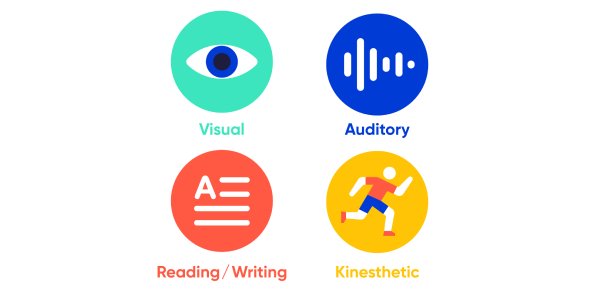
The acronym “VARK” is used to describe four modalities of student learning that were described in a 1992 study by Neil D. Fleming and Coleen E. Mills.
These different learning styles being visual, auditory, reading/writing and kinesthetics were identified after thousands of hours of classroom observation. The authors also created an accompanying questionnaire for educators to give to students to help them identify and understand their own learning preferences.
Visual Learners
Students who best internalise and synthesise information when it is presented to them in a graphic depiction of meaningful symbols are described as visual learners. They may respond to arrows, charts, diagrams and other visualisations of information hierarchy, but not necessarily to photographs or videos.
Because visual learners tend to be holistic learners who process information best when it is presented to them as a robust whole rather than piecemeal, they tend to see positive educational outcomes when they are presented with summarising charts and diagrams rather than sequential slides of information.
Auditory Learners
Auditory (or aural) learners are most successful when they are given the opportunity to hear information presented to them vocally. Because students with this learning style may sometimes opt not to take notes during class in order to maintain their unbroken auditory attention, educators can erroneously conclude that they are less engaged than their classmates. However, these students may simply have decided that note-taking is a distraction and that their unbroken attention is a more valuable way for them to learn.
Auditory learning is a two-way street: Students who fall into this modality often find success in group activities where they are asked to discuss course materials vocally with their classmates, and they may benefit from reading their written work aloud to themselves to help them think it through.
Reading/Writing Learners
Students who work best in the reading/writing modality demonstrate a strong learning preference for the written word. This includes both written information presented in class in the form of handouts and PowerPoint slide presentations as well as the opportunity to synthesise course content in the completion of written assignments. This modality also lends itself to conducting research online, as many information-rich sources on the internet are relatively text-heavy.
Reading/writing-oriented students should be encouraged to take copious notes during classroom lectures to help them both process information and have an easier time recalling it later.
Kinesthetic Learners
Kinesthetic learners are hands-on, participatory learners who need to take a physically active role in the learning process in order to achieve their best educational outcomes. They are sometimes referred to as “tactile learners,” but this can be a bit of a misnomer; rather than simply utilising touch, kinesthetic learners tend to engage all of their senses equally in the process of learning.
Because of their active nature, kinesthetics learners often have the most difficult time succeeding in conventional classroom settings. Some educators have found success encouraging kinesthetic learners to utilise flashcards for subjects like math and English to make rote memorisation into an interactive experience. These students also often thrive in scientific subjects with lab components, as the skills-based, instructional training that occurs in these settings engages them in productive ways.
This post references the University of Kansas, coupled with my learning at the Coaching Institute, Neuro Linguistic Program Train the Trainer Qualification. To find out more drop me a note.
 Stuart Keith
 Dad's My Hero